Cabinetry is 35–45% of a luxury kitchen budget and 100% of the visual character of the room. The wrong material choice doesn't fail loudly — it ages badly over five winters, swells over three summers, and quietly drags the room's perceived quality.
Rift-cut white oak
The current default for warm-modern Massachusetts kitchens. Straight grain, dimensionally stable, takes a clear or smoked finish beautifully. Pairs with travertine, marble, and limewashed plaster.
American walnut
Richer and more formal than oak. Best for libraries, bars, and accent islands — full walnut perimeters can feel heavy in a north-facing MA kitchen.
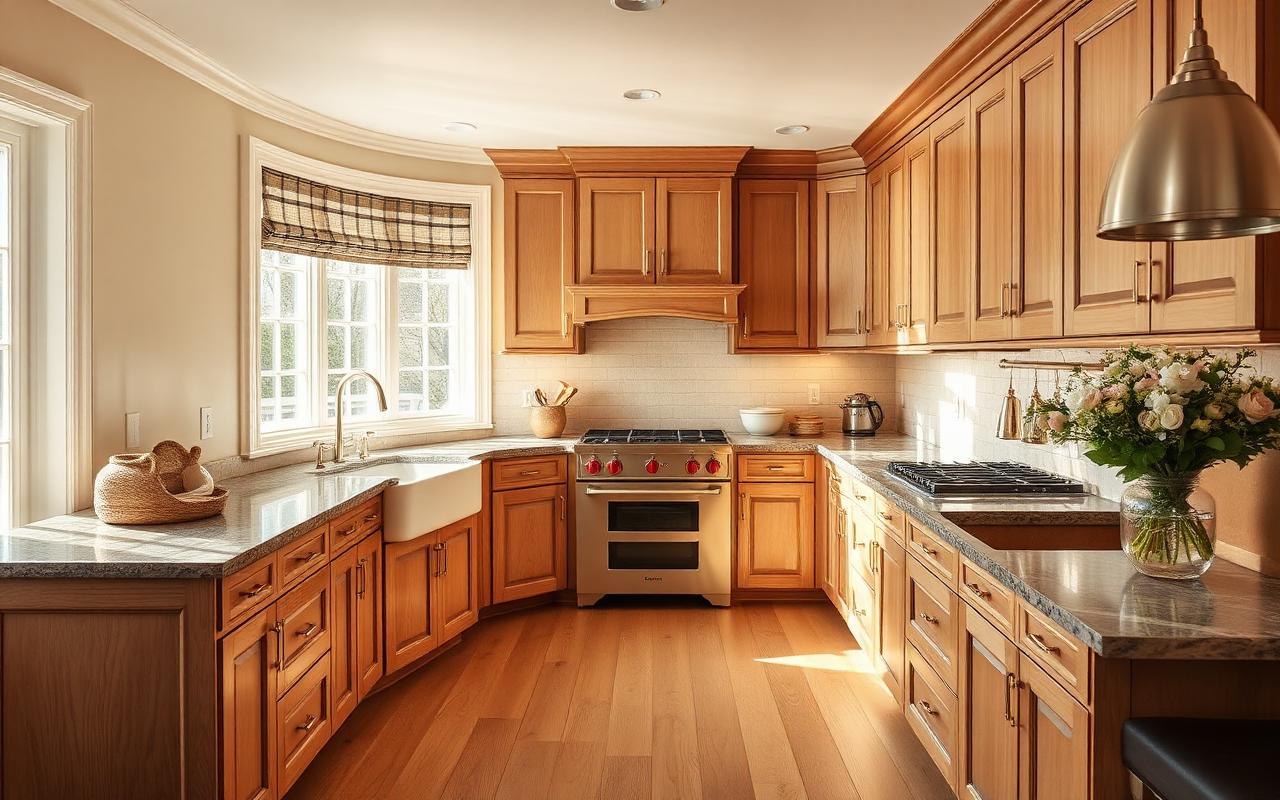
Painted maple (inset shaker)
The period-correct answer in colonials, Victorians, and shingle-style homes across Greater Boston. Choose a tight-grain hardwood substrate and a catalyzed conversion varnish — not a latex paint — for a finish that survives 15 years of daily cleaning.
European lacquer (handleless slab)
High-gloss or super-matte polyurethane on MDF, sprayed in a controlled facility. The only way to get a true seamless slab door. Beautiful, but unforgiving — chips show, and field repairs are nearly impossible.
Thermofoil and laminate
Modern thermofoil from German programs is dramatically better than the 2005 stuff. It still does not belong in a luxury kitchen. Use only in service spaces — laundry, mudroom, secondary pantry.
Our default heuristic
Warm-modern: rift oak. Traditional/colonial: painted inset maple. Contemporary new build: European lacquer or veneered slab. Mix only with intent.
8–22 wks
lead-time range across cabinet materials — plan the calendar around it
Action items
0/7 · 0%Choose your cabinet material in 7 steps
Construction matters more than species
Most clients fixate on wood species — oak vs walnut vs maple — and forget that two cabinets in the same species can have wildly different lifespans depending on how they're built. The box construction, drawer joinery, hinge quality, and finish system together determine whether your kitchen still looks tight at year fifteen. A particleboard box with cam-lock joinery in beautiful rift oak veneer is a 7-year cabinet. A plywood box with dovetail drawers and Blum Movento runners in painted poplar is a 25-year cabinet. Always ask for the construction spec in writing before you compare prices.
Pros and cons at a glance
Rift-cut white oak — Pros: dimensionally stable, ages beautifully, neutral enough to pair with almost any stone. Cons: visible grain limits how minimal a slab door can feel, lead times have stretched to 14–18 weeks at the top European programs.
American walnut — Pros: depth and warmth no other domestic species matches, develops a richer patina over a decade, photographs exceptionally well. Cons: meaningfully more expensive than oak, can darken a north-facing kitchen, shows scratches more than oak on the grain.
Painted inset maple — Pros: period-correct in colonial and Victorian Massachusetts homes, fully refinishable, the easiest material to live with for families with kids. Cons: shows seasonal wood movement at panel joints, requires a high-end conversion-varnish finish to avoid chipping, longer build time than slab cabinetry.
European lacquer — Pros: the only true seamless slab look, near-mirror finish on high-gloss, contemporary and luxurious. Cons: field repairs are essentially impossible, chips show immediately on dark colors, requires near-perfect installation tolerances.
Thermofoil and laminate — Pros: very low cost, hundreds of color and texture options, suitable for utility spaces. Cons: reads as builder-grade in a primary kitchen, edges can lift over time near heat sources, no field repair.
Practical tips from the field
- ·Always specify plywood box construction (3/4" sides minimum) over particleboard — the upcharge is small, the lifespan difference is enormous
- ·Insist on dovetail drawer joinery with a solid hardwood drawer box, not a stapled MDF box
- ·Specify Blum or Grass soft-close hinges and runners — they outlast cabinet boxes by 5–10 years
- ·Order one full-size door sample, not a 6" chip — finishes look different at scale
- ·Photograph your samples in your actual kitchen at 8 AM, noon, and 7 PM before deciding
- ·For painted cabinets, demand a catalyzed conversion varnish — not pre-cat lacquer, never latex
- ·Match the cabinetry interior to the door color; visible white melamine inside a dark cabinet reads cheap
- ·Specify full-overlay or inset construction; partial-overlay framed cabinetry is the visual tell of a mid-grade kitchen
How to budget by material
- ·Painted maple, semi-custom: $1,200–$1,800 per linear foot installed
- ·Rift oak, fully custom: $1,800–$3,200 per linear foot installed
- ·American walnut, fully custom: $2,400–$3,800 per linear foot installed
- ·European lacquer, imported program: $2,800–$5,500 per linear foot installed
- ·Thermofoil (secondary spaces only): $400–$800 per linear foot installed
Massachusetts climate considerations
Greater Boston cycles between 25% interior humidity in February and 65% in August. That 40-point swing causes panel movement, joint stress, and finish failure in cabinets built for a steadier climate. Two implications: avoid wide solid-wood panels (rails and stiles should be glued up from narrower stock), and insist on a moisture-cured finish system that flexes with the wood. Coastal homes on the North Shore and Cape add salt air, which corrodes hardware and accelerates finish breakdown — specify solid brass or 304-grade stainless and budget for hardware replacement every 8–12 years.
The single most common cabinet mistake
Buying on door style and color, not on box and finish. The door is what you see in the showroom; the box and finish are what you live with for two decades.
A 10-year ownership case study
Consider two kitchens completed in 2015. Kitchen A: semi-custom painted maple shaker in a colonial Wellesley home, plywood box, dovetail drawers, catalyzed conversion varnish, Blum runners. Kitchen B: imported European lacquer slab in a contemporary new build, MDF box, cam-lock drawers, water-based finish from a regional shop. By year three, Kitchen A had developed minor seasonal hairline cracks at three painted-panel joints, easily touched up in 30 minutes by the original shop. Kitchen B had three visible chips at door edges that could not be repaired in the field and required full door replacement — the manufacturer's color formula had already shifted slightly, so the new doors did not match. By year ten, Kitchen A looked tight and intentional; Kitchen B had been partially refaced. The design vocabulary of B was more dramatic on day one. The choice of construction made A the smarter spend over a decade.
Finishes — what each system actually does
Catalyzed conversion varnish is the gold standard for painted cabinetry: it cures hard, resists chemicals, and forgives minor wood movement. Pre-catalyzed lacquer is a step below and common in mid-grade shops — fine for 5–8 years, then it shows. Water-based finishes have improved dramatically and are now acceptable for clear-coated rift oak; they are still inadequate for painted cabinetry under daily kitchen abuse. Oil finishes (Rubio Monocoat, Osmo) create a beautiful tactile surface but require seasonal reapplication and accept water marks. Reserve oil finishes for low-water zones — bar cabinetry, library millwork — not the primary kitchen run.
Hardware and the finish-fail vector
Hardware finish failure is the most common visible aging in a luxury kitchen. Plated finishes (polished nickel, polished chrome) wear at high-contact points first — drawer pulls under fingertips, knob facings. Solid brass and stainless develop wear that reads as patina; plating wears to base metal and reads as damage. Specify solid brass (oil-rubbed, satin, unlacquered) or solid stainless across all cabinet hardware in any luxury kitchen — the upcharge per piece is $8–25, the longevity difference is decades. For coastal homes, 304-grade stainless or solid brass is not optional.
Working with your fabricator
- ·Request the door & drawer spec in writing — material, thickness, joinery, finish system, hinge brand
- ·Confirm hinge brand (Blum, Grass, Salice) and that the model is the higher-end soft-close variant
- ·Ask for the finish warranty in writing — minimum 5 years for varnish, 7 for lacquer
- ·Visit the shop floor if possible — well-run shops welcome it; the ones that resist are telling you something
- ·Photograph each cabinet on delivery and note any damage in writing before signing acceptance
- ·Keep one spare door and one spare drawer front from the original batch in storage for future repair
Interactive · quiz
Not sure which fits your home?
Take the 3-minute style quiz — we'll point you toward the right cabinet language.
Take the quizFAQ
Frequently asked questions
Rift-cut white oak with a catalyzed conversion varnish, on a plywood box with dovetail drawers, is the most durable luxury cabinet construction for New England humidity cycles.
Next step